
Trading 212 Review UK: What Does Commission-Free Really Cost?
Trading 212's Invest account, Stocks and Shares ISA, Cash ISA and SIPP reviewed: the full fee list with worked examples, how your shares and cash are protected, interest on cash, the 212 Card, the free-share invite, what users complain about, how to transfer out or close, and who should skip it.
Last updated 12 October 2026

Best for
UK investors who want to buy shares and ETFs, inside a Stocks and Shares ISA or outside one, without paying commission or a platform fee, and who are comfortable running everything from an app.
Cheap to run if you mostly buy and hold. There's no commission and no custody or platform fee, the Stocks and Shares ISA starts at £1, and the one charge Trading 212 itself makes on investing is a 0.15% FX fee when you trade something priced in another currency: £1.50 on a £1,000 US share purchase, and about the same again when you sell. The catches sit elsewhere. Interest on cash stays off until you switch it on, and outside the Cash ISA and SIPP that cash can sit in money market funds that aren't bank deposits. Card deposits cost 0.7% after your first £2,000, a full ISA transfer out sells your fractional shares, and slow transfers and identity checks lead the recent complaints. The free share is worth £8 to £100, so plan on £8: a small extra, not a reason to open the account. Capital at risk.
Pros
- No commission, custody or platform fee on Invest, the ISAs or the SIPP; Trading 212's only charge there is a 0.15% FX fee on trades in another currency
- Stocks and Shares ISA from £1, flexible, with no fee for the wrapper and no Trading 212 charge to transfer an ISA in
- A Cash ISA that tracks Bank Rate minus 0.15%: 3.60% AER (variable) on 12 October 2026, held only in bank deposits
- Fractional shares, Pies and AutoInvest, across what its App Store listing calls 13,000+ stocks and ETFs
- Free bank-transfer deposits, free withdrawals and no inactivity fee
- Shares held apart from the firm's own assets at BNY Mellon and Interactive Brokers, with FSCS investment protection up to £85,000 if Trading 212 fails
Watch-outs
- Interest on uninvested cash is off until you enable it, and outside the Cash ISA and SIPP that cash may sit in money market funds with no deposit protection
- Card, Apple Pay and Google Pay deposits cost 0.7% once you have paid in £2,000 in total, and that allowance never resets
- A full ISA transfer out sells your fractional shares, and transfers of shares out are all or nothing
- Slow ISA transfers out, repeated identity checks and chat support that struggles to resolve problems lead recent one- and two-star app reviews
- The 212 Card's 1.5% cashback is 0% unless you switch on Invest cashback and keep a subscription on the card; it's capped at £15 a month and invested, never paid as cash
- The CFD account sits in the same app, and 76% of retail CFD accounts lose money with this provider
Current related offer
Trading 212 offer pageAd / referral links — we may earn a bonus when you sign up.
Provider
Trading 212
Open an Invest account, Stocks ISA or SIPP through our invite between 21 September and 3 November 2026, then deposit at least that account's minimum within 10 calendar days of opening (£1 for the Stocks ISA). You get a share worth £8 to £100 for a GBP account, picked at random with higher values less common. Its value is locked for 30 days from crediting, and reversal and recovery rules apply. Keep a note of your opening date and when the 30-day lock ends.
Requirement: The account's minimum deposit within 10 calendar days of opening: £1 for the Stocks ISA; check the Invest or SIPP minimum in the app
EasyVerification and funding varyPayout Within 3 business days of qualification; reward value locked 30 days from crediting; SIPP/ISA Invest fallback clocks apply
Verified 12 October 2026 · Ends 3 November 2026
Full claim instructions are on the Trading 212 offer page.
Related comparisons
How Trading 212 works
Trading 212 UK Ltd is an investment firm authorised by the Financial Conduct Authority, firm number 609146, based at Aldermary House in the City of London. That number comes from Trading 212's own terms, so check it on the FCA register before you send money. Everything runs through one app, or the web version, with separate accounts for investing, ISAs, a pension and CFD trading.
Your cash and investments are held under the FCA's client asset rules (CASS, nothing to do with the bank switching service of the same name), apart from Trading 212's own money. Client cash sits with major banks, including J.P. Morgan and Barclays, and shares with the custodians The Bank of New York Mellon and Interactive Brokers. You are the beneficial owner of your shares, although they are registered in Trading 212's name in a pooled (omnibus) account at Interactive Brokers.
So how does a commission-free broker pay its bills? On investing, Trading 212 says its main income is the 0.15% FX fee and share lending; on CFDs, it's the spread and overnight interest. Share lending applies to the Invest account only. Trading 212 lends your shares to borrowers, mostly for short selling, takes collateral of at least 102% of their value in US Treasuries, adjusted daily, and passes you half the interest. You keep any gain or loss and still get your dividends, paid by the borrower as a manufactured payment that can be taxed differently, but you can't vote with lent shares.
You can switch lending off in the Interest on shares dashboard. Trading 212's help centre doesn't say whether it starts switched on, so check the setting when you open the account. Shares in the Stocks and Shares ISA are never lent.
Is your money protected?
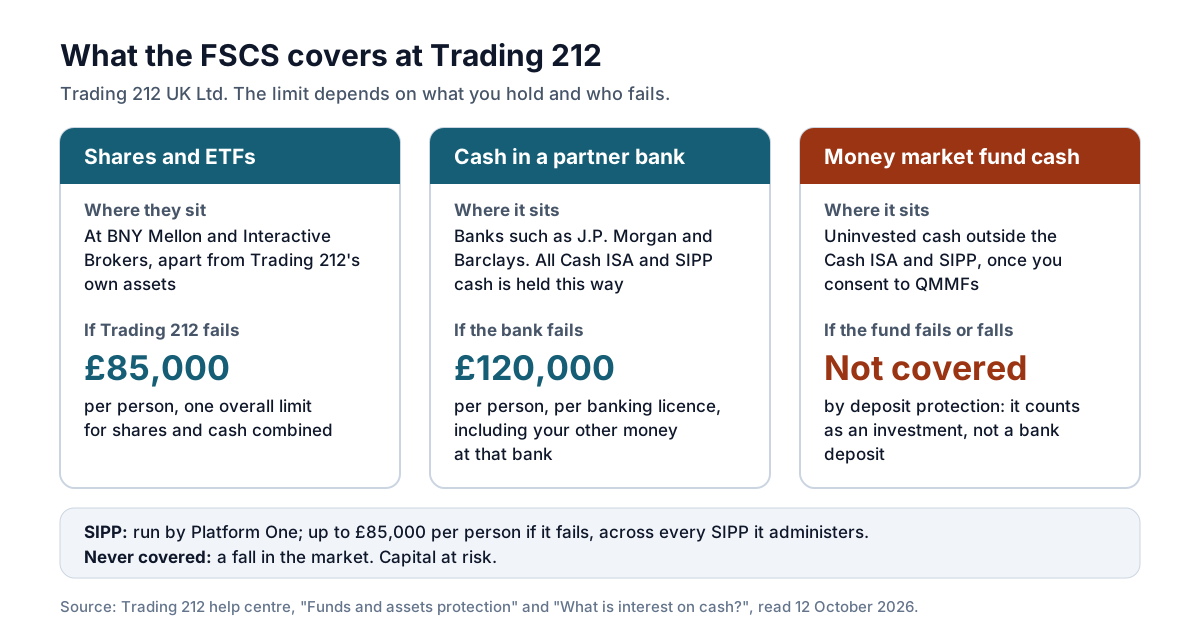
Two different FSCS limits apply, depending on what fails. If Trading 212 itself fails and your shares or cash are lost, the FSCS may pay up to £85,000 per person: one overall limit for shares and cash combined. If one of the banks holding client cash fails, eligible cash is covered up to £120,000 per person per banking licence, and that limit includes any money you hold directly with the same bank.
The gap is cash in money market funds. When you switch on interest, uninvested cash in accounts other than the Cash ISA and SIPP can be placed in qualifying money market funds (QMMFs). Trading 212 says that money is treated as an investment, not as money held with a bank, so deposit protection doesn't apply if a fund fails, and a fund can fall in value. Cash ISA money is never put in QMMFs, and SIPP cash stays in banks.
The SIPP is run by Platform One. If Platform One fails, the FSCS may pay up to £85,000 per person, and that limit covers every SIPP Platform One administers, including any you hold through another provider.
None of this covers the market. If your shares fall, that's investing, not a failure. Capital at risk: investments can go down as well as up, and you may get back less than you put in.
The accounts: Invest, ISAs, SIPP and CFD
Invest is a general investment account for shares and ETFs, with gains and dividends taxed in the normal way. Its minimum deposit is published on Trading 212's Terms and Fees page; check it there or in the app before you fund. The Stocks and Shares ISA is the same investing with no UK tax on gains or dividends, from a £1 minimum deposit. It's a flexible ISA, so money you take out can go back in within the same tax year without using more of your allowance, and there's no managed version. You need to be a UK resident aged 18 or over, and the £20,000 yearly allowance is shared across all your ISAs, wherever they are.
The Cash ISA pays 0.15% below the Bank of England's Bank Rate. With Bank Rate at 3.75% on 12 October 2026 (the next decision is due on 5 November 2026), that's 3.60% AER, variable, which matches the App Store listing. Interest builds daily and is paid on the 3rd of each month, the money is held only in bank deposits, and if Trading 212 widens the gap to Bank Rate it must give you 14 days' written notice. Its help centre also flags a government change from 6 April 2027: under-65s will be able to put at most £12,000 a year into a Cash ISA, within the same £20,000 total.
The SIPP is a self-invested pension administered by Platform One. You need to be a UK resident aged 18 to 74 with a National Insurance number, and US persons can't open one. Trading 212 claims basic-rate tax relief for you, which usually arrives within 6 to 11 weeks. It only takes personal contributions, so your employer can't pay into it. You can usually take money out from age 55, rising to 57 from 2028.
The CFD account is leveraged trading on price movements, not owning shares, with a 0.5% FX fee, variable spreads and overnight interest. Trading 212's own warning: 76% of retail investor accounts lose money when trading CFDs with this provider. Nothing in this review recommends it, and it doesn't count for the free share.
Inside Invest and the Stocks and Shares ISA you can buy fractional shares, build Pies (a basket of investments split by percentages you set) and use AutoInvest to fund them on a schedule. The App Store listing claims 13,000+ stocks and ETFs and 13 currencies, and there's a practice account with virtual money if you want to try the app first.
Fees, line by line
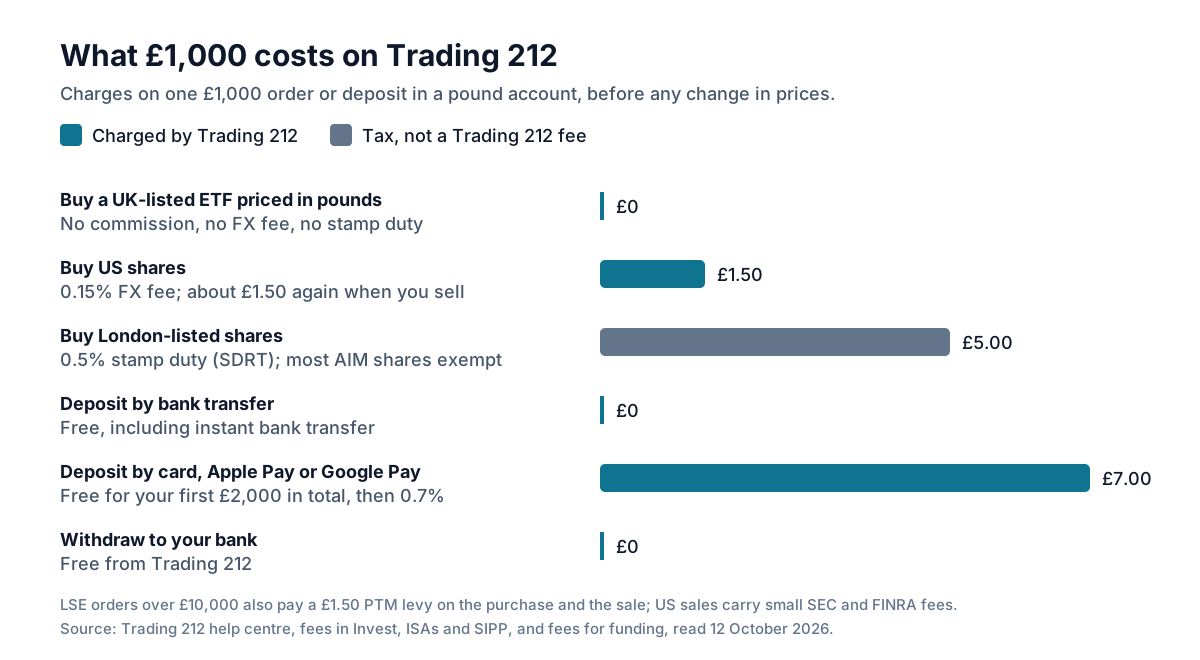
For Invest, the ISAs and the SIPP, Trading 212 says the only fee it can charge is the FX fee: 0.15% of the trade when you buy or sell something priced in a currency other than your account's, including inside Pies. Commission and custody are free, there's no inactivity fee, and dividends are converted without the FX fee. Every charge shows on the Review order screen before you confirm.
Other charges come from exchanges and tax authorities, not Trading 212. Buying shares listed on the London Stock Exchange costs 0.5% Stamp Duty Reserve Tax; ETFs, gilts and bonds don't pay it, and most AIM shares are exempt. LSE orders over £10,000 pay a £1.50 PTM levy on both the purchase and the sale. US sales carry small SEC and FINRA fees, and buying shares in French companies with a market value over 1 billion attracts a 0.4% financial transaction tax.
Paying in by bank transfer or instant bank transfer is free. Cards, Apple Pay, Google Pay and Klarna are free until you have deposited £2,000 in total, then cost 0.7% each time, and that allowance doesn't reset. Withdrawals are free from Trading 212, although the receiving bank could charge.
What it costs in practice
Take £1,000 at a time in a pound account. A UK-listed ETF priced in pounds costs nothing to buy. £1,000 of US shares costs £1.50 in FX fees, and selling them later costs about the same again, depending on what they're worth by then. £1,000 of London-listed shares costs £5 in stamp duty, which is a tax, so you'd pay it at any UK broker. A £1,000 card deposit costs £7 once the £2,000 free allowance is used up, which is why bank transfer is the way to pay in.
So for a buy-and-hold investor in pound-priced funds the dealing costs are close to zero, while someone trading US shares pays 0.15% each way. That adds up with activity: buying and selling £1,000 of US shares ten times a year costs about £30 in FX fees.
For anyone with savings, interest is worth more than the free share. £10,000 in the Cash ISA at 3.60% AER earns about £360 over a year if the rate doesn't change, tax-free. The free share is worth £8 to £100, with higher values less common: a nice extra, not the main event.
Interest on cash, and where that cash sits
Uninvested cash in Invest, both ISAs, the SIPP and the CFD account can earn interest, with no minimum or maximum balance. It's paid daily, except in the Cash ISA, which pays monthly. It isn't automatic: you open Interest on cash in the app and tap Enable, and for accounts that can use money market funds you also have to consent to them. One recent App Store reviewer had left cash in the account for a year before finding out interest was never switched on.
Trading 212's App Store and Google Play listings advertise 3.8% on pounds. The rate for new clients is published on its Terms and Fees page, and existing customers see their own rate in the app. It's variable, and outside an ISA or pension the interest may be taxable.
Remember where the money goes. In Invest and the Stocks and Shares ISA, cash you've agreed to put in QMMFs has no deposit protection, and Trading 212 lists credit, liquidity and interest-rate risks for those funds. If you want cash that stays in bank deposits, the Cash ISA and the SIPP keep it there.
The 212 Card
The 212 Card is issued by Paynetics, with Trading 212 running the app and support; you need an Invest account to get one. There's a one-off fee for the physical card; check the amount on the Terms and Fees page before you order. The card arrives by untracked post within up to 10 business days. Cash machine withdrawals are free up to £400 a month, then cost 1%, and there's no Trading 212 fee for using the card abroad.
The cashback headline is 1.5%, but the base rate is 0%. To get 1.5% you have to switch on Invest cashback, which puts every penny into a Pie you choose (so it's invested, never paid as cash), and keep at least one active subscription on the card that recurs every five days to one month, such as a streaming service. Drop either one and the rate goes back to 0%. Cashback is capped at £15 a month, which you reach at £1,000 of eligible spending a month, so £180 a year at most.
Refused cashback also comes up in recent app reviews, and subscriptions paid through a digital wallet or payment intermediary may not be detected. Check that the Card Home screen shows both conditions as active.
The free share invite
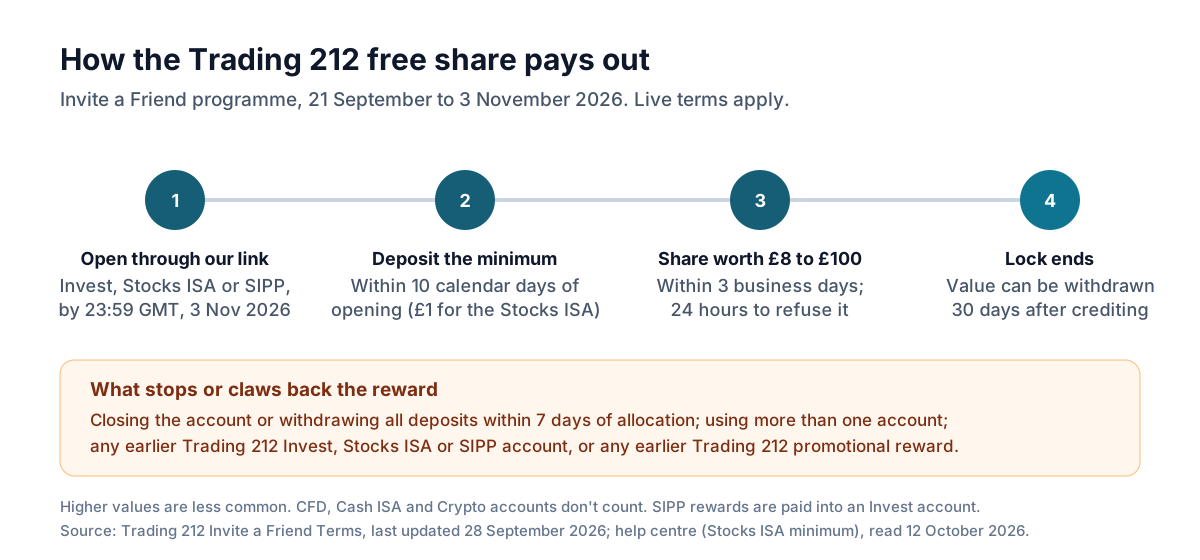
Open an Invest account, Stocks and Shares ISA or SIPP through our link between 21 September and 23:59 GMT on 3 November 2026, then deposit at least that account's minimum within 10 calendar days of opening. For the Stocks and Shares ISA that's £1. Trading 212 publishes the Invest and SIPP minimums on its Terms and Fees page, so check the figure there or in the app before you fund. The reward arrives within 3 business days of qualifying.
It's a share, possibly a fraction of one, worth £8 to £100 for a pound account and picked at random. Trading 212 says higher values are less common and publishes the odds on its invite page. Plan on £8 and treat anything more as luck. Occasionally the reward may be paid as cash of the same value instead. You can refuse it within 24 hours of it being allocated, but you won't get a replacement.
Its value is locked for 30 days from crediting: you can sell the share, but not withdraw the money. Sell at a loss and only the proceeds stay locked; your other cash and investments aren't affected. A reward in the Stocks and Shares ISA counts towards your £20,000 allowance, and if you've already used the allowance it goes to an Invest account instead, which you have six weeks to open if you don't have one. A reward earned through the SIPP is always paid into Invest, and if you don't have an Invest account you must open and activate one within 10 days of qualifying or lose the reward.
You can't get it if you have ever held an Invest, Stocks and Shares ISA or SIPP account with any Trading 212 company, or had any Trading 212 promotional reward before, through a promo code or an invite, on any account type. CFD, Cash ISA and Crypto accounts don't count. Trading 212 can withhold or claw back the reward if you use more than one account, or if you reverse a qualifying step, including closing the account or withdrawing everything you deposited within 7 calendar days of the reward being allocated. It doesn't combine with other promotions, Trading 212 staff and their relatives are excluded, and Trading 212 can change or end the programme without notice. Our free share guide walks through it step by step.
Disclosure: the invite link on this page is GetQuids' own, so when you qualify, Trading 212 gives us a reward too. It rewards an inviter for at most five people per campaign. None of this changes your reward.
What users complain about
On 12 October 2026 the Trading 212 app was rated 4.7 from 407,226 ratings on the UK App Store and 4.7 from about 269,000 on Google Play. Its Trustpilot profile scored 4.6 from 105,299 reviews, 79% of them five-star and 5% one-star, and the company had replied to 99% of negative reviews.
We read the 500 most recent UK App Store reviews, from 12 May to 9 October 2026; 89 gave one or two stars. The recurring themes: ISA transfers out that take weeks of chasing; identity checks with repeated face scans, camera trouble on iPads, and accounts locked or refused without a reason; crashes and "something went wrong" errors; chat support that people find slow to resolve problems; promotion disputes, such as an invite that wasn't attached or finding out about ineligibility only after doing everything; too many notifications and prompts to leave a review; and, on the CFD side, slippage and stop-losses. Interest on cash that was never switched on and refused card cashback came up too, but only once each.
Opening, transferring and closing
To open an account you need an identity document (for UK customers a passport, identity card, driving licence or residence permit, issued by your country of residence or nationality), sometimes a proof of address, and a motion selfie taken in the app on a phone. Trading 212 can ask for more. Card deposits usually arrive in under 10 minutes and bank transfers within 3 business days.
Transferring an ISA in costs nothing on Trading 212's side, as cash or as the investments themselves (in specie), and doesn't use your allowance. Your old provider may charge, and a cash transfer means selling and buying back, so you're out of the market in between. Transferring out is where the friction is: transfers of shares out are always in full, a full transfer sells any fractional shares as of the day it's approved, and Trading 212 aims to finish within HMRC's 30-day maximum but can put your ISA on sell-only while it moves. Cash transfers out can be partial.
Withdrawals take up to 3 business days, and you need two-factor authentication set up before you can request one. To close, open the menu, then My account, Account details and Close account. That closes every account type at once, so sell your shares, close any CFD positions and withdraw the balance first. If you took the free share, closing within 7 days of the reward being allocated lets Trading 212 claw it back.
Who should use it, and who should skip it
Consider it if you want a low-cost Stocks and Shares ISA or general account for shares and ETFs, invest small regular amounts through Pies, or want a Cash ISA that tracks Bank Rate in the same app. It suits people who pay in by bank transfer and are happy to manage everything themselves.
Skip it, or keep it as a second account, if you want a managed ISA (there isn't one), want your employer to pay into your pension (the SIPP takes personal contributions only), or expect to move your ISA soon and hold fractional shares. Leave the CFD account alone unless you fully understand leverage, and don't open any account just for the free share: with £8 as the floor, it won't cover a mistake.
FAQ
- Is Trading 212 safe?
- It's an FCA-authorised firm (number 609146, according to its own terms) that keeps client money and shares apart from its own under CASS rules. If it fails, the FSCS may cover up to £85,000 per person; cash at a failed partner bank is covered up to £120,000 per banking licence. Cash in money market funds and falls in the market aren't covered.
- Is Trading 212 really free?
- There's no commission, custody or platform fee, but there is a 0.15% FX fee on trades in other currencies, 0.5% stamp duty on London-listed shares (a tax) and 0.7% on card deposits after your first £2,000. Bank transfers in and withdrawals are free.
- Can I lose money with Trading 212?
- Yes. Shares, ETFs and the free share itself can fall in value, and the FSCS doesn't cover market losses. On CFDs, 76% of retail investor accounts lose money with this provider.
- How do I get the free share?
- Open an Invest account, Stocks and Shares ISA or SIPP through our link by 23:59 GMT on 3 November 2026, and deposit at least the minimum (£1 for the Stocks and Shares ISA) within 10 calendar days. You must never have held one of those accounts or had a Trading 212 promotional reward before. The share, worth £8 to £100, arrives within 3 business days.
- When can I withdraw the free share's value?
- 30 days after it's credited. You can sell it sooner, but the money stays locked until then. Closing the account or withdrawing all your deposits within 7 days of the reward being allocated can cost you the reward.
- Does Trading 212 pay interest on cash?
- Yes, but you have to switch it on under Interest on cash and, for accounts that use money market funds, consent to them. The Cash ISA pays Bank Rate minus 0.15%, 3.60% AER on 12 October 2026, from bank deposits only.
- Can I transfer my ISA to or from Trading 212?
- Yes. Transfers in cost nothing on Trading 212's side, as cash or as investments. Transfers of shares out are always in full, and any fractional shares are sold first. Trading 212 aims to finish within HMRC's 30-day maximum.
- Does Trading 212 lend out my shares?
- Only in the Invest account, never in the Stocks and Shares ISA. You get half the interest, Trading 212 holds collateral of at least 102% of the shares' value, and you can switch lending off in the app.
Featured in these guides
Trading 212 review: commission-free investing, the ISA, and what's actually free
An honest look at Trading 212's Invest account and Stocks & Shares ISA: the real fee list, FSCS protection, the free-share referral, and the catches to know before you open an account.
7 min readTrading 212 free shares: campaign, funding and withdrawal checks
Check the current invitation campaign, country-specific funding and reward rules, and the difference between selling a share and withdrawing its value.
5 min readUK free-share offers: product fit, fees and withdrawal restrictions
Understand investment sign-up rewards without confusing selling a share, withdrawing proceeds or eligible compensation with cash in your bank.
5 min readUK sign-up offers for beginners: budget, eligibility and evidence
A practical starting point for people in Britain: distinguish cash from vouchers, calculate costs and choose one suitable sign-up or cashback offer.
5 min read