
Wealthyhood Review: No Commission, No ISA. Is It Worth It?
Wealthyhood reviewed: who runs it and how your money is protected, what you can buy, Basic vs Plus vs Gold, whether a paid plan pays for itself, the Savings Vault, fees, what users complain about and who should skip it.
Last updated 12 October 2026

Best for
UK residents who want a simple app for building a portfolio of stocks and ETFs from £1 with no commission, and who don't need an ISA or pension for this money.
On the free Basic plan Wealthyhood is a cheap way to invest: no commission, no custody fee, and a 0.25% FX fee only when your pounds are converted, for example to buy a US share. The big gap is tax: it only offers a general investment account, with no ISA or SIPP, so gains and dividends above your tax-free allowances can be taxed. The paid plans are hard to judge, because Wealthyhood doesn't publish how the 1% or 4% bonus dividend is worked out or capped. There is no joining reward at the moment, so judge it on the app alone.
Pros
- No commission on 5,000+ stocks and ETFs, and no custody fee on any plan
- Fractional investing from £1 per stock or ETF, or £20 for a whole-portfolio buy
- The Basic plan costs nothing, and paying in, withdrawing and closing the account are free
- Portfolio templates, monthly repeating investments and automatic rebalancing
- A Savings Vault in money market funds paying up to 3.88% (variable, depending on plan)
- Investments held by a third-party custodian, separate from Wealthyhood's own money, with FSCS cover up to £85,000
Watch-outs
- No ISA or SIPP, so gains and dividends above your allowances can be taxed
- Market orders only, and ETFs trade once a weekday in a set window
- A 0.25% FX fee whenever your pounds are converted, for example for US shares
- Wealthyhood doesn't explain how the paid plans' bonus dividend is calculated or capped
- Support is email and in-app chat only, and slow replies are the most common complaint
- Fractional shares can't be moved to another provider, so leaving means selling them
Current related offer
Wealthyhood offer pageAd / referral links — we may earn a bonus when you sign up.
Provider
Wealthyhood
Wealthyhood isn't paying anyone to join right now: we can't find a current sign-up reward. It is still a tidy UK app for investing in stocks and ETFs from £1 with no commission on the free Basic plan, but it has no ISA. If that suits you, open an account through Wealthyhood's official site. Capital is at risk.
Easy5-10 minutesPayout No joining reward, so nothing is paid out
Verified 12 October 2026
Full claim instructions are on the Wealthyhood offer page.
Related comparisons
What Wealthyhood is and how your money is protected
Wealthyhood is an investing app run in the UK by Wealthyhood Ltd, a London company incorporated in September 2019 (Companies House number 12190343). It isn't authorised by the FCA in its own right: it is an appointed representative of RiskSave Technologies Ltd, an FCA-authorised firm (FRN 775330), and gives its own FCA register number as 933675. Look up both numbers on the FCA register before you send money. Customers in the EU are served by a separate Greek company under different terms; this review covers the UK service only.
The service is execution-only and non-advised. Wealthyhood passes your orders to a third-party broker, doesn't tell you what to buy and doesn't check whether an investment suits you.
Your investments are held by a third-party custodian, WealthKernel Limited, in client asset accounts under your name, separate from Wealthyhood's own money. Cash you pay in sits in a segregated client money account with the same custodian, and Wealthyhood says it doesn't lend out your money or investments.
If Wealthyhood or its custodian failed and couldn't return your money or investments, the FSCS can pay up to £85,000 per investor. It never covers a fall in the value of what you bought.
What you can buy, and what's missing
Wealthyhood lists more than 5,000 commission-free stocks and ETFs: individual shares from the US, UK, Europe and other markets, and ETFs covering shares, bonds, commodities, property and themes such as clean energy or artificial intelligence. US-listed ETFs, REITs and crypto aren't available. You can put as little as £1 into a single stock or ETF, or £20 into a portfolio buy that splits your money across your chosen holdings.
There is one account type: a general investment account. Wealthyhood's terms describe no ISA, SIPP, Junior ISA or joint account, and its UK site lists none. Without an ISA, capital gains and dividends above your yearly tax-free allowances count towards your tax bill, and Wealthyhood doesn't give tax advice. For most long-term savers it works better alongside an ISA than instead of one.
Wealthyhood files a W-8BEN form for you, which cuts the US tax taken from US dividends from 30% to 15%. Dividends on fractional shares are paid in proportion to what you hold. There is no leverage, margin or short selling.
One thing to know before you build a big holding: fractional shares can't be moved to another provider. If you leave, any fractions are sold and you take the cash.
How orders, automation and rebalancing work
Every order is a market order: you buy or sell at the going price, which can differ from the price the app shows when you tap, and there are no limit orders. Orders for individual shares placed during US market hours (9:30am to 4pm New York time) go for execution straight away; outside those hours they wait for the next session. ETFs are traded once each weekday in a trading window that the app shows before you confirm; place an order after the window has started and it goes into the next business day's window.
The automation is the app's main draw. You can set up one repeating investment a month, collected by Direct Debit and invested across your portfolio, and switch on automatic rebalancing, which runs on the first Monday of each month at 12pm. A rebalance sells overweight holdings in one trading session and buys underweight ones in the next, and you can't sell anything until it has finished.
Wealthyhood works on iPhone, Android and the web at app.wealthyhood.com, although its terms say some features are only fully available in the mobile app. Logging in has no password: Wealthyhood emails you a code each time, or you can use Apple or Google sign-in, so keep your email account secure.
Basic, Plus or Gold?
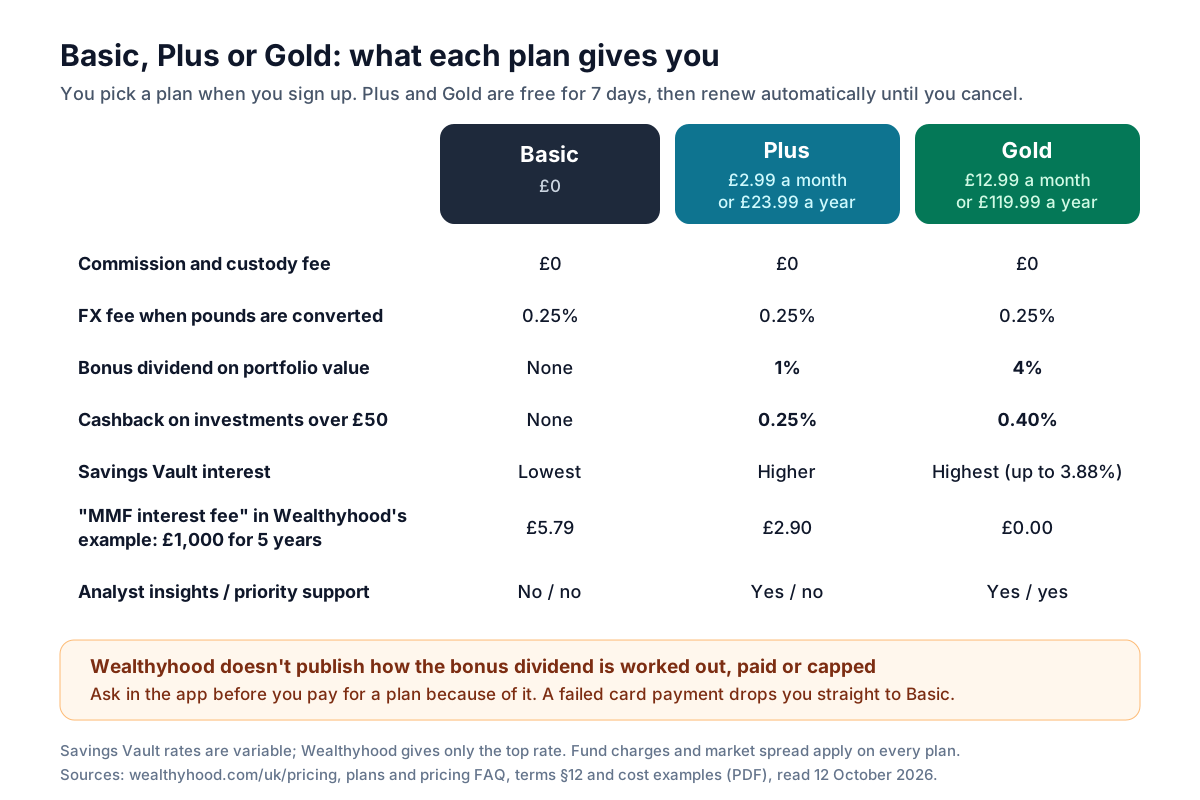
Basic is free and includes commission-free investing, fractional shares, portfolio automation, the Savings Vault and Wealthyhood's learning guides.
Plus costs £2.99 a month or £23.99 a year and adds analyst insights and news, a 1% bonus dividend on the value of your portfolio, 0.25% cashback on investments over £50 and a higher Savings Vault rate. Gold costs £12.99 a month or £119.99 a year and raises those to a 4% bonus dividend, 0.40% cashback and the top Savings Vault rate, plus priority customer service.
Both paid plans start with a 7-day free trial and then renew automatically, billed in full at the start of each month or year. To stop that, change it under Billing or Plans in the app before the trial ends. If a card payment fails you drop straight to Basic, and the terms let Wealthyhood use or sell assets in your account to cover fees you owe. Upgrading starts a new billing cycle at once, with the unused part of your current fee credited towards the new one; downgrading takes effect at once too, and the unused part is credited towards future charges rather than refunded.
Does a paid plan pay for itself?
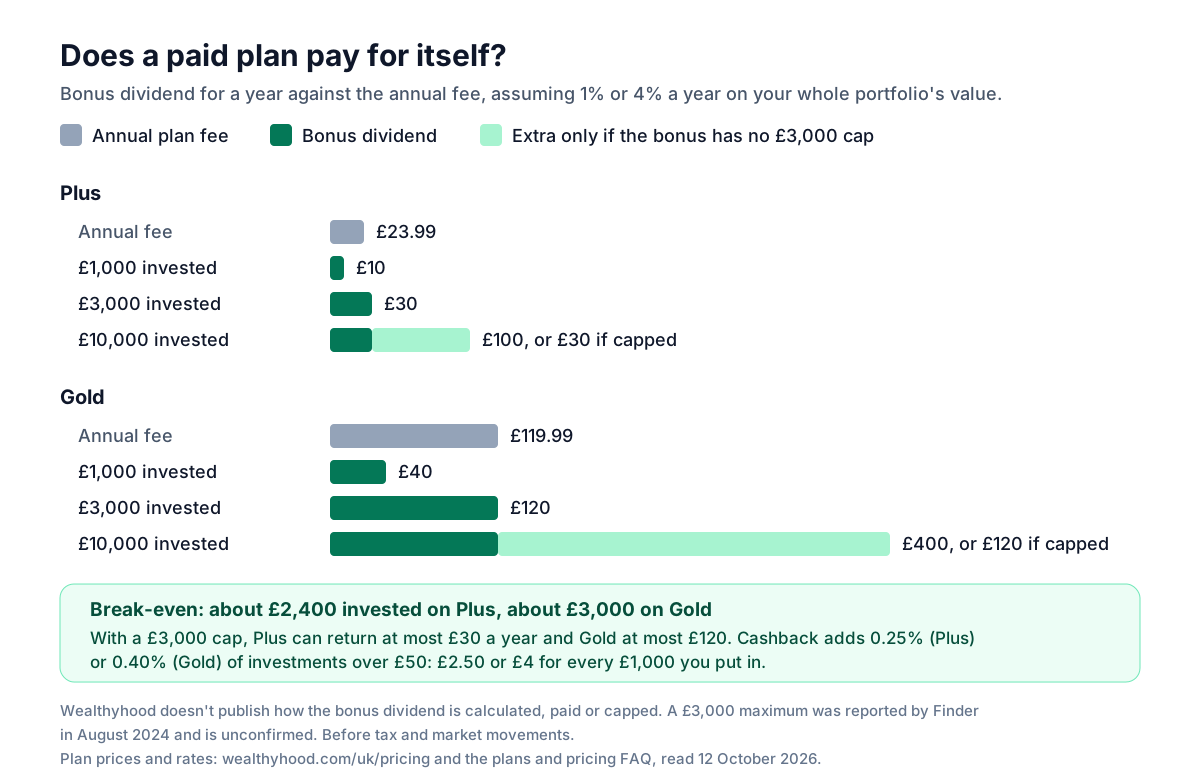
It depends on the bonus dividend, and that is the part Wealthyhood doesn't explain: its pricing page and help centre give the 1% and 4% figures, but not how they are calculated, when they are paid or whether there is a limit. Finder's review, last updated in August 2024, described the bonus as paid monthly with a £3,000 maximum. Wealthyhood's own pages don't mention it, so ask in the app chat before you pay for a plan because of it.
If the bonus is a yearly rate on your whole portfolio, Plus covers its £23.99 fee from about £2,400 invested and Gold covers its £119.99 from about £3,000. If that maximum still applies and means only the first £3,000 of your portfolio counts, Plus can return at most £30 a year and Gold at most £120, so Gold can do no more than roughly break even and Plus comes out a few pounds ahead.
Cashback adds little: 0.25% or 0.40% of investments over £50 is £2.50 or £4 for every £1,000 you put in. The Savings Vault difference is small too: in Wealthyhood's own cost example, £1,000 held for five years in its sterling money market fund loses £5.79 in 'MMF interest fee' on Basic, £2.90 on Plus and nothing on Gold.
Basic is enough to try the app. If you start a Plus or Gold trial to look around, put a reminder in your diary for day 6.
The Savings Vault
The Savings Vault puts your cash into a money market fund. Wealthyhood's cost examples use the BlackRock ICS Sterling Liquidity Fund, which has its own 0.10% yearly charge. On 12 October 2026 Wealthyhood advertised up to 3.88% depending on your plan; it doesn't publish the rate for each plan, and the rate is variable. The yield the app shows is the previous day's return multiplied by 365, after fees.
Interest builds up through the month, is paid into the vault at the start of the next month and is reinvested automatically. Money you add before the daily cut-off is invested the same working day. You can only withdraw to your Wealthyhood cash balance, which can take up to a day, before it can be sent to your bank.
It is an investment, not a savings account. Wealthyhood describes it as an alternative to one, and there is no lock-up, but its value can fall, and FSCS cover only applies if Wealthyhood or its custodian fails, not to a drop in the fund's value.
Fees and catches
Wealthyhood charges no commission, no custody fee and nothing to pay in, withdraw or close your account, though your own bank may charge. It does charge a 0.25% FX spread on top of the spot rate whenever your pounds are converted for an order, which in its own example costs £2.50 on £1,000 put into a US dollar ETF and nothing on an ETF traded in pounds. Dividends paid in other currencies are converted to pounds before they reach you. The funds' own charges and the market spread come on top on every plan, for example 0.22% a year on the Vanguard FTSE All-World ETF in Wealthyhood's example.
The custody fee is £0 'currently': Wealthyhood says it would give advance notice before charging one, and it can change its terms on 14 days' notice.
Two catches that matter if you plan to leave money and forget it. If you don't log in for 365 days, Wealthyhood can close your account, and unless it agrees otherwise with you, closing means your investments are sold, perhaps at a bad moment. Wealthyhood can also close an account on 30 days' notice, and may have to if you move to a country it doesn't serve.
What users complain about
On 12 October 2026 the Wealthyhood app was rated 4.7 from 72 ratings on the UK App Store and 4.2 from 488 reviews on Google Play, where it has more than 50,000 downloads. On Trustpilot Wealthyhood scored 4.5 from 43 reviews, 89% of them five-star and 9% one-star, and Trustpilot notes that it doesn't reply to negative reviews. These are small samples, and five of the 21 written reviews on the UK App Store, all five-star, were posted on the same day, 27 February 2024.
Praise centres on the app's design and how easy it is to use. The low-rated reviews repeat a few themes: slow or unhelpful replies from email and chat support, a sell order stuck for weeks and an account locked, poor warning about changes to the app, a deposit taking two days, no instant trades and a limited ETF range. Older reviews complain that fees and minimums trapped small balances, but those predate the current pricing.
Support is by email (hello@wealthyhood.com) or the in-app live chat; Wealthyhood lists no phone line, and Gold members get priority. If a complaint isn't resolved, you can take it to the Financial Ombudsman Service.
Opening, cancelling and closing
You need to be 18 or over and live in the UK, and you can only have one account, in your own name. Sign-up asks for personal details and runs identity, anti-money-laundering and sanctions checks; Wealthyhood may ask for ID or proof of address. It says verification usually takes a few minutes, or a few hours if it needs more information. You choose a plan during sign-up: Basic is free. There is no joining reward at the moment: Wealthyhood currently runs no refer-a-friend programme that we can find, so open your account through Wealthyhood's official site or its app.
You can cancel within 14 calendar days of opening the account by emailing hello@wealthyhood.com or closing the account in the app. Wealthyhood sells your investments within 2 business days and returns the money; if prices have fallen you get back less, and you pay any costs of selling.
After that you can close at any time under Profile > Account details > Close your account, or by email. Your investments are sold within 2 business days and the money, with any cash, reaches your bank in up to 5 business days. Closing is permanent and plan fees already paid aren't refunded.
Who should use it, and who should skip it
Consider it if you want a tidy app for building and automating a portfolio of stocks and ETFs on the free plan, if you invest small amounts and like fractional shares from £1, or if you already use your ISA allowance elsewhere and want a separate general account.
Skip it if you want an ISA or pension, if you need limit orders or ETF trades at a time of your choosing, if you want phone support, if you'd be paying for Gold mainly for the bonus dividend, or if you might forget about the account for a year. Whatever you buy can fall in value.
FAQ
- Is Wealthyhood safe?
- Your investments and cash are held by a third-party custodian, WealthKernel, separate from Wealthyhood's own money, and the FSCS can pay up to £85,000 per investor if Wealthyhood or the custodian fails. Wealthyhood is an appointed representative of an FCA-authorised firm, RiskSave Technologies (FRN 775330). Nothing protects you from the market falling.
- Does Wealthyhood offer an ISA?
- No. It offers a general investment account only, with no ISA or SIPP, so gains and dividends above your yearly tax-free allowances can be taxed.
- What does Wealthyhood cost?
- The Basic plan is free, with no commission or custody fee. Plus costs £2.99 a month or £23.99 a year and Gold £12.99 a month or £119.99 a year; both start with a 7-day free trial and then renew automatically. A 0.25% FX fee applies whenever your pounds are converted.
- Can I place limit orders?
- No. Every order is a market order. Orders for individual shares placed outside US market hours wait for the next session, and ETFs trade once each weekday in a set window.
- What happens to fractional shares if I leave?
- They can't be moved to another provider. If you leave, any fractions are sold and you take the cash, so prices on the day they are sold affect what you get back.
- Is the Savings Vault a savings account?
- No. It invests your cash in a money market fund paying up to 3.88% (variable, depending on your plan). Its value can fall, and FSCS cover doesn't protect against that.
- Can I phone Wealthyhood?
- No phone line is listed. Support is by email at hello@wealthyhood.com or through the in-app live chat, with priority support on the Gold plan.