
Skrill Money Transfer Review UK: What Does a 'Zero-Fee' Transfer Really Cost?
Skrill Money Transfer reviewed for UK senders: who holds your money, what the exchange-rate markup costs on a real transfer, card fees, delivery times, verification and frozen accounts, the £10 referral credit and its contradictory terms, what users complain about and who should skip it.
Last updated 12 October 2026
Best for
People in the UK sending an occasional transfer to a bank account or mobile wallet in one of Skrill's listed countries, who will check what the recipient gets against the mid-market rate before paying.
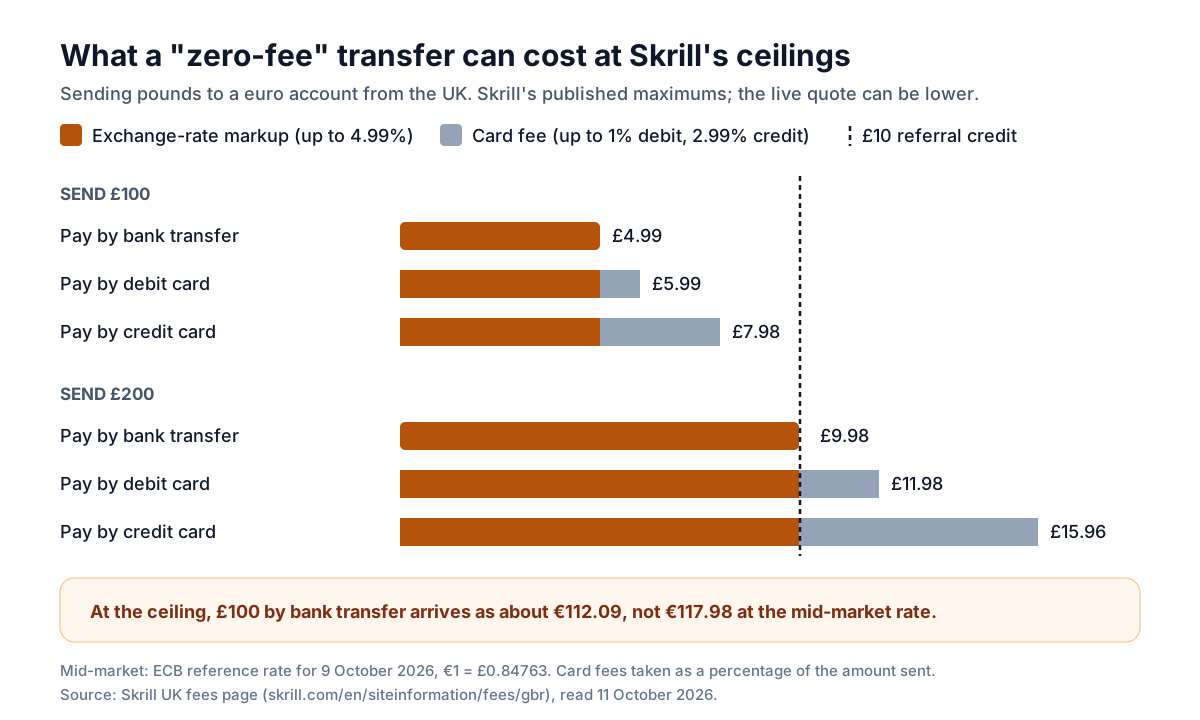
Skrill Money Transfer is easy to use, but 'zero fees' only means there is no upfront fee when you pay by bank transfer. Skrill makes its money on the exchange rate, with a markup of up to 4.99%: at that ceiling, £100 sent to a euro account arrives as about €112.09 instead of €117.98, a cost of about £4.99, and paying by card adds up to 1% (debit) or 2.99% (credit). The £10 referral credit roughly cancels the worst-case markup on one £200 transfer, but it isn't cash, it expires after three months, and Skrill's own terms disagree on whether a new member can use it on their first transfer. Use Skrill when the live quote, after any credit, gives your recipient more than another provider would. It is an e-money account with no FSCS cover, so don't keep money in it.
Pros
- No transfer fee when you pay by bank transfer, and recipients pay Skrill nothing to receive
- Pays out to bank accounts in 39 listed countries, and to mobile wallets in Kenya, Nepal, the Philippines and Sri Lanka
- Skrill's terms say a card payment usually reaches the recipient the same day
- Skrill Limited is authorised by the FCA as an e-money institution, and unresolved complaints can go to the Financial Ombudsman Service
- You see the fee and exchange rate before you confirm, and can set daily rate alerts
- £10 of transfer credit each for you and the person who refers you, after a £100 transfer abroad
Watch-outs
- The real cost is an exchange-rate markup of up to 4.99%, which 'zero fees' doesn't show
- Paying by card adds up to 1% (debit) or 2.99% (credit), and same-currency transfers can cost up to 4.99%
- No FSCS protection: it is an e-money account, not a bank account
- Paying by bank transfer usually takes 2 to 5 days under the terms, despite 'arrives in minutes' in the marketing
- No cancelling once you submit, and a €5 monthly fee if you don't log in or transact for six months
- Recent App Store reviews are mostly one-star, about frozen accounts, verification loops and chatbot-led support
Current related offer
Skrill Money Transfer offer pageAd / referral links — we may earn a bonus when you sign up.
Provider
Skrill Money Transfer
Join Skrill as a new member through a personal invite and send at least £100 abroad to earn £10 of transfer credit. The credit comes off your next eligible transfer of £100 or more (clause 3.6 also mentions use on the first, so check the checkout), expires after three months and isn't cash.
Requirement: One completed transfer of at least £100, excluding fees or taxes, to a recipient in another country; using the credit needs another eligible £100+ transfer
Medium5-10 minutes; if Skrill asks for ID, finish the check within 4 daysPayout Credit appears in Refer a Friend after the qualifying transfer and comes off your next eligible transfer; it expires 3 months after you earn it
Verified 12 October 2026
Full claim instructions are on the Skrill Money Transfer offer page.
Related comparisons
What Skrill Money Transfer is
Skrill Money Transfer sends money from your debit card, credit card or bank account to a bank account or mobile wallet abroad. It lives inside a Skrill account, so you have to open one first, but it isn't the Skrill wallet: you can't pay for a transfer from your Skrill balance, and the money only passes through your account on its way out. Transfers to a business can only go to a bank account.
For UK customers the service is provided by Skrill Limited (company 4260907), which its terms say is authorised by the Financial Conduct Authority under the Electronic Money Regulations 2011, register number 900001. Skrill's FAQ page names a different company, Paysafe Payment Solutions Limited, regulated by the Central Bank of Ireland. The UK terms are the contract, so we have gone with those. We couldn't load the FCA register entry itself, so the number comes from Skrill's own disclosure.
Skrill tells you to send money only to people or businesses you know. Its terms ban sending on someone else's behalf and using the service to take a cash advance on a credit card. Sending from one Skrill wallet to another is a separate feature with its own 2.99% fee (minimum €0.50), and it isn't what this review covers.
How your money is protected
Skrill is an e-money institution, not a bank. Its account terms say plainly that the Financial Services Compensation Scheme (FSCS) doesn't apply to a Skrill account and that if Skrill became insolvent you could lose the electronic money held in it. E-money rules are designed to keep customers' funds safe and available, but that is not deposit insurance. The terms say transfer money only passes through your account momentarily, so the exposure is mainly any balance you leave there, for example after a failed transfer has been refunded to it.
Skrill may hand a transfer to a payment partner for the last leg. Its terms say its own obligation ends once that partner has been credited, although complaints still go to Skrill first. If Skrill doesn't resolve a complaint, you can take it to the Financial Ombudsman Service.
Once a transfer is submitted you can't cancel or reverse it. Check the recipient's details twice, and never send money to someone you have only met online.
Fees: where Skrill makes its money
Skrill's UK fee page lists no transfer fee when you pay by bank transfer. Paying by debit card, PaysafeCash or bank transfer through Klarna costs up to 1%, and paying by credit card up to 2.99%. Recipients pay Skrill nothing, although the terms say their own bank or wallet provider may charge them to receive.
The catch is the exchange rate. When your pounds are converted, Skrill applies a markup of up to 4.99% per transaction, and its FAQ is open about it: the service 'may make money on the exchange of currencies'. If no conversion is needed because the send and receive currency are the same, the fee page lists a send fee of up to 4.99% instead. A transfer that starts and ends in the same country counts as domestic, at up to 2%.
All of these are maximums, and Skrill shows the fee and rate before you confirm. The fee page doesn't say how the live markup is set for each currency, so the only reliable test is the quote in front of you.
One fee applies even if you never send anything: if you neither log in nor make a transaction for six months, Skrill deducts a service fee of €5 (or the equivalent) every month.
What a transfer really costs, and what the £10 credit is worth
To put numbers on the ceiling we measured it against the mid-market rate: the European Central Bank's reference rate for 9 October 2026, €1 = £0.84763, or about €117.98 for £100. At the full 4.99% markup, taken as 4.99% off that amount (Skrill doesn't publish how it applies it), £100 paid by bank transfer arrives as about €112.09, so the recipient gets roughly €5.89 (about £4.99) less. On £200 the gap is about £9.98. A debit card adds up to £1 per £100 on top, and a credit card up to £2.99.
That puts the referral credit in proportion: £10 roughly cancels out the worst-case markup on one £200 transfer. Skrill's promo page calls it '£10 off', but we couldn't see in a checkout whether it lowers what you pay or raises what is sent. Either way, compare the amount your recipient will get with what another provider quotes for the same transfer before you pay; our Wise review works through one alternative's costs.
Countries, currencies and payout options
Skrill's country list, read on 11 October 2026, has 39 destinations, including the UK itself: 21 that are paid in euros, plus Australia, Bangladesh, Brazil, India, Indonesia, Kenya, Malaysia, Mexico, Nepal, Pakistan, the Philippines, Poland, Sri Lanka, Thailand, Ukraine, the United States and Vietnam. Other Skrill pages say 'over 40 countries' and 'more than 40 different currencies', so check the calculator for your route.
Every destination on the list pays into a bank account, and Kenya, Nepal, the Philippines and Sri Lanka can also receive to a mobile wallet. The money arrives in the currency you choose when you start the transfer.
How long a transfer takes
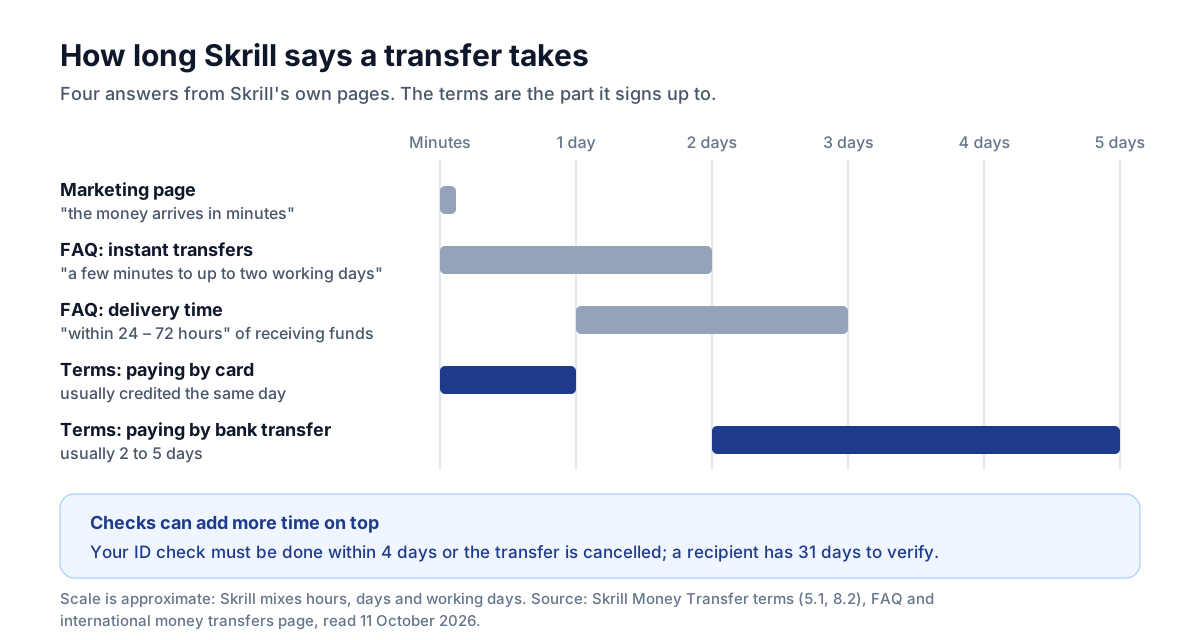
Skrill gives four different answers. The marketing page says the money 'arrives in minutes'. The FAQ says 'a few minutes to up to two working days' in one answer and 'within 24 – 72 hours' of receiving your funds in another. The terms, which are the contract, say a card payment is usually credited to the recipient the same day, while a bank transfer usually takes 2 to 5 days.
So if speed matters, the terms point to paying by card, which costs up to 1% on a debit card. Checks can slow things down: if the recipient has to verify their identity and doesn't within 31 days, the transfer is declined and refunded. Skrill's FAQ says you can send at any time, weekends included, but when the money lands still depends on the route.
Limits, verification and frozen accounts
Transfer limits depend on how far you have verified your account, how you pay, where you live and where the money is going, and Skrill can change them. When you hit a limit, Skrill asks for a copy of your ID and a proof of address; if you don't complete that within four days, the transfer is cancelled. Cards and bank accounts you pay from must be in your own name, and you can only hold one Skrill account.
If Skrill can't complete a transfer, it makes three attempts to refund your card or bank account and then credits your Skrill balance instead. That balance can't be used for another Skrill Money Transfer: you can only spend it with online merchants or withdraw it, and the fee page lists withdrawal fees that depend on the method.
Restricted or closed accounts are the most serious complaint in user reviews, with people describing accounts frozen soon after a first payment and money stuck while documents are reviewed. Send what you need to send, have your ID and proof of address ready, and don't use the account to store money.
The £10 referral credit
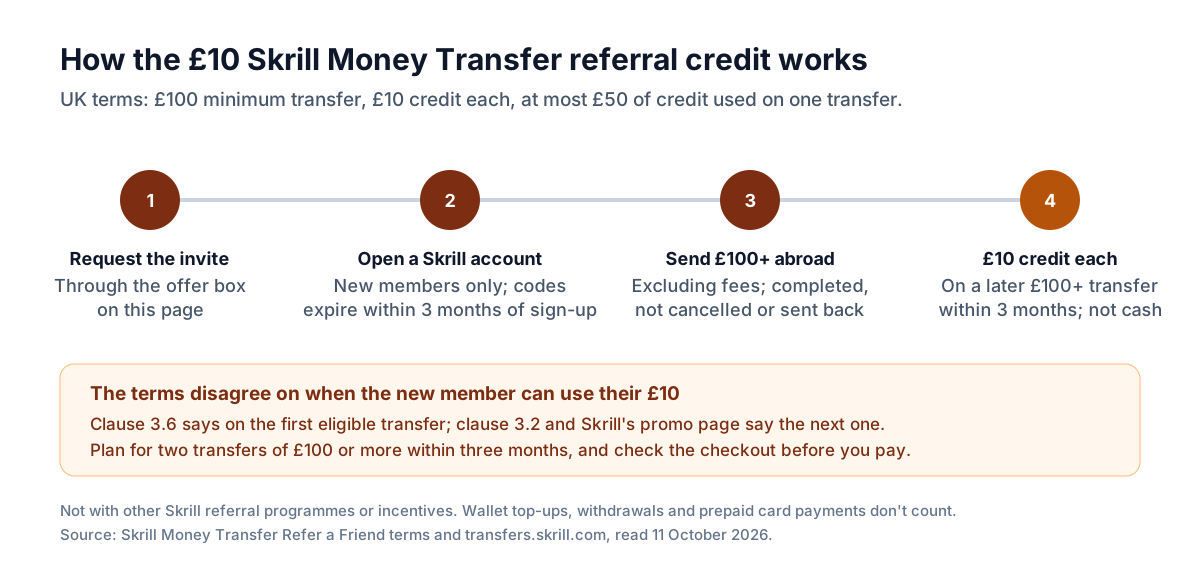
Under Skrill's Refer a Friend terms, a new member who signs up with a personal referral code or link and completes an eligible transfer gets £10 of transfer credit, and so does the person who referred them. You only count as a new member if you don't already have a Skrill account when you are referred. An eligible transfer must go to a recipient in a different country, be at least £100 excluding fees or taxes, and complete successfully. It doesn't count if it is cancelled, if the money is sent back to the referrer, or if it is a Skrill Prepaid Mastercard payment or a wallet top-up or withdrawal.
Credit appears in the Refer a Friend section of your account and, under clause 3.4, comes off your next eligible transfer, so you need to send at least £100 abroad again to use it. It expires three months after you earn it, can't be exchanged for cash or moved to another account, and no more than £50 of credit can be used on one transfer. If a transfer that used credit fails, the credit comes back. Codes can't be combined with other Skrill referral programmes or incentives, and the terms say referral codes expire within three months of signing up.
The terms contradict themselves on timing. Clause 3.2 says both people get credit 'that can be used in your next Eligible Transaction', and Skrill's promo page says 'both of you will get £10 off your next international money transaction'. Clause 3.6 says the new member's credit 'can be used immediately with their first Eligible Transaction'. Plan as if you will need a second transfer of £100 or more within three months, and look at the checkout before you pay rather than assuming the first transfer is £10 cheaper.
An existing member only gets a code after completing their own eligible transfer, and can share it with up to 50 people for personal, non-commercial use. Disputes about the amount of credit must be raised within 30 days of it being added; formal notices go to help@skrill.com. Skrill can end the programme or change the amounts with two months' notice, and unused credit is lost if your account is closed.
What users complain about
On 11 October 2026 the Skrill app was rated 4.5 from 9,018 ratings on the UK App Store and 4.4 from about 240,000 reviews on Google Play. The recent written reviews tell a different story: of the 100 most recent UK App Store reviews (29 May 2025 to 25 September 2026), 77 gave one star and 17 gave five. Both apps cover the whole Skrill wallet, not just money transfers.
Trustpilot splits the two. Skrill's main profile scores 3.7 from about 27,850 reviews (65% five-star, 25% one-star), and Skrill replies to 89% of negative reviews. The Skrill Money Transfer profile scores 4.3 from 13,583 reviews (85% five-star, 4% one-star), though only 507 of those were posted in the last 12 months.
The recurring complaints are accounts restricted or closed soon after the first deposit with money stuck, verification that loops or rejects documents, no phone line and chatbot-led support with cases closed without an answer, scams through Skrill-to-Skrill payments that couldn't be recovered, transfers arriving later than promised, and exchange rates worse than rival apps. Praise for the transfer service centres on speed, no upfront fee and an easy app.
Signing up, sending and closing
You need to be 18 or over, open a Skrill account (one per person) and add a payment method in your own name. Depending on how you pay, Skrill may ask for extra verification. Request the invite through the offer box on this page before you sign up; if it gives you a code, enter it when you sign up or, at the latest, with your first transfer.
To send, choose the two countries in Skrill's calculator, enter the amount and currency, pick how you will pay, enter the recipient's details (name, country and bank account number or IBAN, or mobile wallet), check the summary and confirm, then complete the payment. Skrill emails a summary and keeps your history under My Transfers.
You can close the account at any time through Customer Service; within 14 days of opening, the terms say closing costs nothing. Withdraw any balance first: the account terms say fees for inactive accounts can continue after closure, and any unused referral credit is lost.
Who should use it, and who should skip it
Consider it if you send money now and then to one of Skrill's listed countries, particularly to a mobile wallet in Kenya, Nepal, the Philippines or Sri Lanka, and you will compare the live quote with the mid-market rate each time. With the referral credit it can be worth it for two transfers of £100 or more within three months, provided the quote after the credit holds up.
Skip it if you would rather see the cost as a separate fee than buried in the rate, if you want FSCS protection for money you keep, if you can't afford to have money held up during verification, or if you already have a Skrill account, because the referral credit is for new members only.
FAQ
- Is Skrill Money Transfer free?
- Only in the sense that there is no transfer fee when you pay by bank transfer. Skrill adds an exchange-rate markup of up to 4.99%, and paying by card costs up to 1% (debit) or 2.99% (credit). Compare the amount your recipient will get.
- Is my money safe with Skrill?
- Skrill Limited says it is authorised by the FCA as an e-money institution (register number 900001). The FSCS doesn't cover Skrill accounts, so don't keep a balance there. Unresolved complaints can go to the Financial Ombudsman Service.
- How long does a Skrill transfer take?
- The terms say a card payment usually reaches the recipient the same day and a bank transfer usually takes 2 to 5 days. Identity checks on either side can add time.
- Can I pay for a transfer from my Skrill balance?
- No. Skrill Money Transfer has to be paid by card or bank; the terms exclude your Skrill balance.
- Can I cancel a transfer?
- No, not once it is submitted. If Skrill can't complete it, it makes three attempts to refund your card or bank account, then credits your Skrill balance.
- When can I use the £10 referral credit?
- On a later eligible transfer of at least £100 abroad, within three months of earning it. Skrill's terms disagree on whether a new member can use it on their first transfer, so check the checkout before you pay.
- Can I get the referral credit if I already have a Skrill account?
- No. The terms only treat you as a new member if you don't have a Skrill account when you are referred.
- How do I close my Skrill account?
- Contact Skrill's Customer Service; within 14 days of opening, closing costs nothing. Withdraw any balance first, and remember the €5 monthly fee if you don't log in or transact for six months.