
Chase UK Review: Worth Opening for the £50 Referral and 2% Cashback?
Chase UK reviewed: who runs it, the £50 referral and every condition, the 2% cashback rules, the savings rates, what the app-only account can't do, the complaints and who should skip it.
Last updated 11 October 2026
Best for
People who want a free second account for spending abroad, everyday cashback and a high-interest saver, and who can move £1,000 in from another bank within 30 days.
Chase makes a strong second account and a weaker main one. The referral is simple: £50 for paying in £1,000 from another bank within 30 days, and the money doesn't have to stay once the £50 arrives. Leave that £1,000 in the boosted Saver, though, and it earns about £45 of interest in a year while meeting the savings half of the cashback rules, which takes our illustration to about £155 in year one. The catches are real: no overdraft, joint accounts, cash deposits or international payments, a cashback rule you can fail with one bad day, and frozen accounts come up again and again in user reviews.
Pros
- £50 each for you and the friend who referred you, for paying in £1,000 within 30 days; the money doesn't have to stay
- 2% cashback on groceries, commuting, fuel, restaurants and takeaways, up to £20 a month
- No Chase fees on card spending or cash withdrawals abroad, at the Mastercard exchange rate
- New customers can open a saver paying 4.5% AER for 12 months (2.25% of it fixed) in their first 31 days
- Free extra current accounts, a numberless card, and card freezing or new card details in the app
- People on the phone or in-app chat 24/7, and deposits protected by the FSCS up to £120,000
Watch-outs
- The £50 goes to a rewards balance; you move it to a Chase account yourself, and lose it if you leave without redeeming
- Cashback needs 15 payments and £1,000 in savers on every day of the previous month
- No overdraft, no joint accounts and no cash or cheque deposits
- No international payments in or out, and no CHAPS
- App only: no internet banking and no branches
- Frozen accounts and held payments are a recurring complaint, and Trustpilot scores Chase 3.5
Current related offer
Chase UK offer pageAd / referral links — we may earn a bonus when you sign up.
Provider
Chase UK
Chase pays you £50 when you activate a single-use referral code in the app and pay in £1,000 in total within 30 days of opening your first account. Chase only lets customers send codes to people they know, so request a private invite from this page rather than relying on a public code. Move the £50 out of Rewards before you ever leave Chase.
Requirement: Activate a personal single-use code and pay in £1,000 in total within 30 days of opening your first Chase account
MediumApproval and invitation availability varyPayout Added to your rewards balance straight away once you reach £1,000 (Chase emails you); redeem it before leaving Chase
Verified 11 October 2026
Full claim instructions are on the Chase UK offer page.
Related comparisons
Chase UK vs Monzo Referral Offers
Chase UK vs Monzo referral offers compared by reward size, account setup, qualifying action and payout friction.
Read comparison →
Chase UK vs Zopa Biscuit Referral Offers
Chase UK vs Zopa Biscuit compared by reward, what you must do, app-bank setup and payout timing.
Read comparison →
What Chase is
Chase is a trading name of J.P. Morgan Europe Limited, part of JPMorgan Chase. Chase says the company is authorised by the Prudential Regulation Authority and regulated by the FCA and the PRA, Financial Services Register number 124579. Eligible deposits are protected by the FSCS up to £120,000 per person, and that limit covers all your Chase accounts together.
It is a separate bank from Chase in the US: if you move to the US, you would need to open a new account with Chase there. Chase says that if you move abroad it can't keep you as a customer, and suggests withdrawing your money and closing your accounts before you go.
Everything runs through the app. There is no internet banking and no branch; the other way in is phone support on 0800 376 3333, which Chase says is answered by people, around the clock. Money comes in by Faster Payments or BACS from a UK account in pounds, and accounts are for personal use only, not for a business or for holding someone else's money.
The current account: what it does and doesn't do
The current account is free: no monthly fee, no minimum monthly pay-in and no Chase fees at cash machines. The debit card is a numberless Mastercard, with the details kept in the app. You can freeze it, get new card details without waiting for a new card, and add it to Apple Pay or Google Pay. Extra current accounts are free, which helps if you like separate pots for bills and spending. If you want Chase as your main account, the Current Account Switch Service moves your balance and payments in 7 working days, free and covered by the Current Account Switch Guarantee. The current account itself pays no interest; that comes from the savers below.
The list of things it doesn't do is long for a main account. Chase doesn't allow overdrafts, takes no cash or cheque deposits, doesn't offer joint accounts and can't send or receive money internationally. It can't accept CHAPS or Swift payments either, and you can only send money within the UK, in pounds.
Limits: you can send up to £25,000 a day to other UK accounts. Chase can approve a one-day increase up to £1m if you ask in the app, but only deals with requests between 8am and 6pm on weekdays. Cash withdrawals are capped at £500 a day, with a further limit of £1,500 a calendar month abroad. There is no limit on paying into the current account.
The savings accounts
Chase Saver: 2.25% AER (2.23% gross) variable, easy access, with no minimum and up to £3m across your savers. Chase's own example has £1,000 growing to £1,022.50 in a year. You can open several and each earns interest.
Saver with a boosted rate: in your first 31 days as a new customer you can open one Chase Saver with a boosted rate. It pays the standard variable rate plus a 2.25% AER boost fixed for 12 months, which makes 4.5% AER (4.41% gross) today; if the standard rate moves, your total moves with it. Chase's example: £1,000 becomes £1,045.00 after 12 months and £1,068.51 after 24. The terms say it is for customers Chase tells are eligible and can be withdrawn at any time, so open it as soon as it appears in your app.
Round-up account: rounds your card spending up to the nearest £1 and pays 5% AER (4.89% gross) variable on the spare change. On the anniversary of opening, the balance moves to the Chase account you pick. It doesn't count towards the cashback savings rule.
Regular Saver: 6.5% AER (6.31% gross) fixed for 12 months on up to £300 a month, one per customer. Paying in the full £300 every month gives £3,725.53 after a year by Chase's figures, £125.53 of it interest. You can take money out at any time without a fee or penalty from Chase.
Interest is taxable above your Personal Savings Allowance: £1,000 a year for basic-rate taxpayers, £500 for higher-rate and nothing for additional-rate. Chase also offers investing through J.P. Morgan Personal Investing, a separate company; Chase notes that those investments aren't backed by Chase itself, and your capital is at risk.
How the 2% cashback works
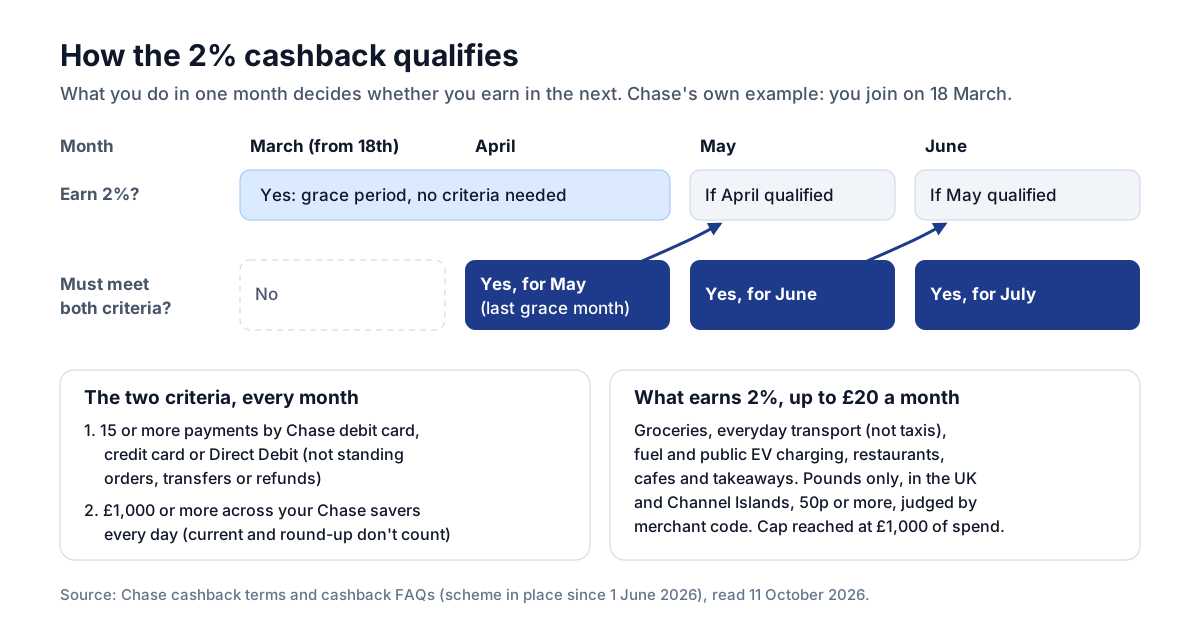
Since 1 June 2026 (1 July for customers who were on the older Everyday Cashback offer), Chase pays 2% cashback on groceries, everyday transport (not taxis), fuel and public EV charging, restaurants and cafes, and takeaways, up to £20 a month. You hit the cap at £1,000 of eligible spending. It works on the Chase debit and credit cards, including through Apple Pay, Google Pay and PayPal, for payments in pounds in the UK and the Channel Islands of 50p or more. Chase decides eligibility from the shop's merchant category code, so a purchase that looks right can still miss out, and Chase warns that paying through Curve or Klarna may not earn.
The qualifying rule is the catch. To earn in a month, the previous month needs both: 15 or more payments by Chase card or Direct Debit (standing orders, transfers and refunds don't count), and at least £1,000 across your Chase savers on every single day. One day under £1,000 costs you the next month's cashback. New customers get a grace period for the rest of the month they join and all of the next, when the 2% is paid regardless.
Cashback lands in your rewards balance once the payment clears and is taken back if you return the item. Chase can change the scheme and says it will usually give 30 days' notice of a material change.
The £50 referral
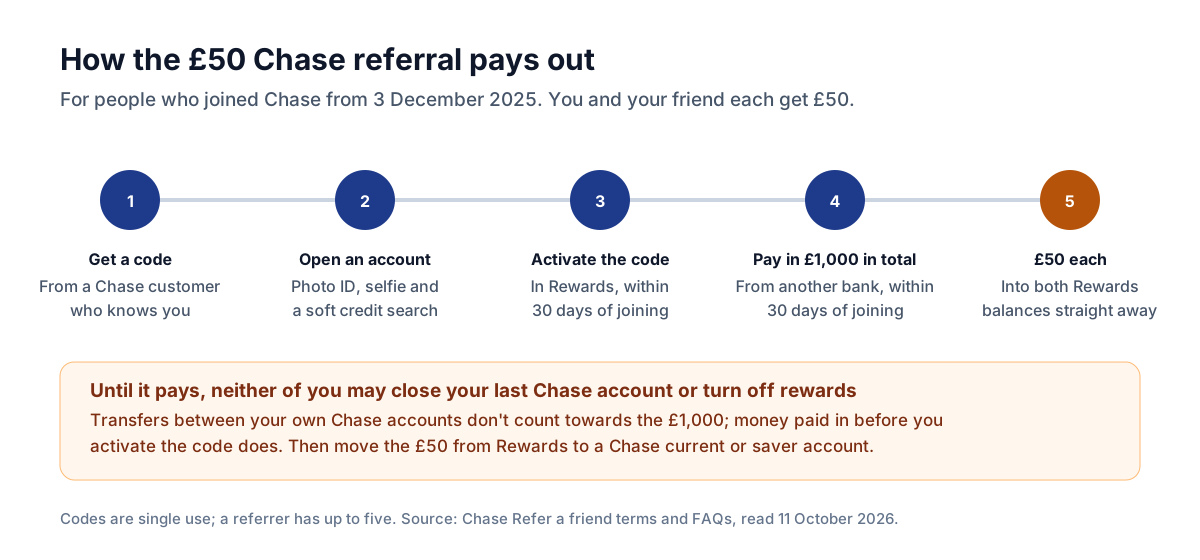
Chase's current Refer a friend offer pays £50 to you and £50 to the person who referred you. You need to be eligible to join and must not have applied to Chase before 3 December 2025. Open your account, then in the app go to Rewards, tap 'Been referred by a friend?' and enter the code within 30 days of opening your first Chase account. In the same 30 days, pay in at least £1,000 in total.
The £1,000 can arrive in several payments and you can spend in between: Chase's own example is paying in £500, spending £250 and paying in another £500. Money paid in before you activated the code counts, but transfers between your own Chase accounts don't. When you reach £1,000, Chase says the £50 goes into both rewards balances straight away and it emails you. Neither of you may close your last Chase account or turn off rewards before then. Afterwards, move the £50 to a Chase current or saver account: a balance left in Rewards is lost if you leave.
Codes come only from Chase customers who see the offer in their app. Each gets up to five single-use codes, and Chase's terms say they may only send them to people they know and mustn't share them publicly for paid promotion. A code linked to someone who misses the conditions is gone for good. A code published on a website may already have been used, which is why we don't publish one: request an invite from our offer page instead.
Chase can change, suspend or end the offer, telling you by app, SMS or email, and can take the reward back if it suspects abuse. JPMorgan staff can't refer other staff or JPMorgan clients.
What it's worth
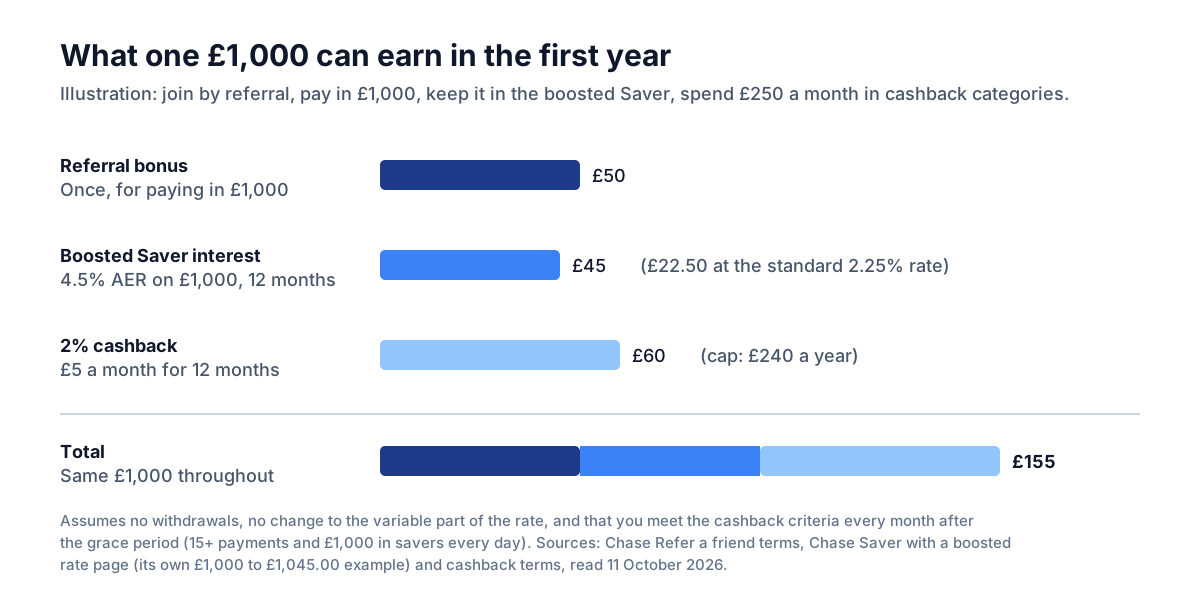
The £50 is the clearest money here, but the account is built so the same £1,000 keeps working. Pay it in for the referral, move it into the boosted Saver within your first 31 days, and it earns interest while meeting the £1,000-every-day half of the cashback rule.
Our illustration: £50 from the referral, £45 of interest over 12 months (Chase's own 4.5% example, assuming no withdrawals and no change to the variable part of the rate), and £60 of cashback from £250 a month of eligible spending, if you qualify every month. That is about £155 in the first year. At the standard Saver rate the interest would be £22.50, and cashback tops out at £240 a year if you spend £1,000 a month in the eligible categories.
After the first year the boost ends and the referral was a one-off, so the case rests on the cashback and the fee-free spending abroad. If you can't keep £1,000 in savings every day or don't make 15 card payments a month, the cashback disappears and Chase becomes a free account with a decent saver.
Spending abroad and the credit card
Chase charges no fees on card payments or cash withdrawals abroad and uses the Mastercard exchange rate, which you can check in the app's currency converter. Pay in the local currency: if you choose pounds, the merchant sets the rate. The cash machine's owner may still add its own fee, although withdrawals are free at Chase ATMs in the United States. Cash is limited to £500 a day and £1,500 a calendar month abroad, and nothing spent abroad or in another currency earns cashback. Check that payments outside the UK are switched on under card controls before you travel.
Once you have a current account, you can check in the app whether you are eligible for the Chase credit card without affecting your credit score. It has no annual fee and no foreign exchange fee, 0% on purchases for up to 3 months if you make your minimum repayments, and a representative 24.9% APR variable on a £1,200 credit limit. You need no bankruptcies, CCJs or IVAs in the last 6 years and must pass credit and affordability checks. Chase doesn't charge a fee for credit card cash withdrawals but charges interest on them until they are repaid.
What customers complain about
On 11 October 2026 the Chase UK app was rated 4.9 from 285,442 ratings on the App Store and 4.8 from more than 120,000 on Google Play. Trustpilot is cooler: 3.5 from about 16,000 reviews, 63% of them five-star and 19% one-star, and Trustpilot shows Chase replying to 82% of the negative ones.
The 50 newest UK App Store reviews on 11 October 2026 (14 September to 9 October) were 36 five-star and 6 one-star, and the newest one-star reviews on Trustpilot cover the same ground. The themes that repeat: accounts frozen or money held for checks with no timescale given, slow account closures, repeated requests for ID and selfies, forced app updates before you can use the app, slow transfers, former customers unable to rejoin, and losing a whole month's cashback after dipping under £1,000 in savers for a day. Others are about what Chase doesn't offer, such as interest on the current account and cash deposits, or about savings rates dropping when a promotional rate ends.
Applying and closing
You need to be 18 or over, live in the UK and be a UK tax resident, with a smartphone and a UK mobile number. You apply in the app with an in-date passport, UK driving licence or EU national ID card and a selfie, plus your address, a verified email address and details of your job, income and spending. Chase runs a soft credit search and must be happy with your credit history. Its published service figures say that, once it has everything it needs, 97% of customers get an account number the same day (99% within 6 days), and the debit card takes 7 days on average; the card details work in the app straight away.
You can cancel within 14 days by closing the accounts in the app or contacting Chase, and close at any time after that, free, by contacting Chase. Before you start closing your last current account, move and redeem your rewards balance, including any referral £50 or cashback; Chase says it can't be redeemed afterwards. If you are moving abroad, Chase asks you to close your accounts before you go.
Who should get it, and who should skip it
Get it if you want a free second account for spending abroad, already spend a few hundred pounds a month on groceries, travel and eating out, can park £1,000 in savings and leave it there, or want the boosted Saver or Regular Saver rates. If you can move £1,000 in from another bank, the referral alone makes the first month worthwhile.
Skip it if you need an overdraft, a joint account, cash deposits or international payments, if you want internet banking on a computer, if you can't spare £1,000 within 30 days, or if you live outside the UK or are about to move. And if a frozen account would leave you stuck, keep your main account somewhere else.
FAQ
- Is Chase UK a proper bank, and is my money protected?
- Yes. Chase is a trading name of J.P. Morgan Europe Limited, authorised by the PRA and regulated by the FCA and the PRA. Eligible deposits are protected by the FSCS up to £120,000 per person across all your Chase accounts.
- Is Chase UK the same as Chase in the US?
- No. It is a separate bank that only operates in the UK, so if you move to the US you would need a new account with Chase there. Chase says it can't keep customers who move abroad and suggests closing your accounts before you go.
- How do I get the £50 referral bonus?
- Request a private invite from our offer page to get a code, open an account, enter the code under Rewards within 30 days of opening your first account, and pay in at least £1,000 in total from another bank in the same 30 days. You must not have applied to Chase before 3 December 2025.
- Do I have to leave the £1,000 in the account?
- No. The rule counts what you pay in, not your balance, and the £50 arrives as soon as you reach £1,000. Transfers between your own Chase accounts don't count. Keep the account open and rewards switched on until the £50 is paid, and remember the cashback rule needs £1,000 in savers every day.
- Where do I get a referral code?
- Only Chase customers who see the offer in their app can create codes, up to five each, and each works once. Chase's terms say they should only send them to people they know, so we don't publish one: request a private invite from our offer page.
- Does applying affect my credit score?
- Chase runs a soft credit search to check your credit history when you apply for the current account. Checking whether you are eligible for the Chase credit card in the app doesn't affect your score either.
- Does Chase offer an overdraft or joint accounts?
- No. Chase doesn't allow overdrafts and doesn't currently offer joint accounts. It also can't take cash or cheque deposits, or send and receive money internationally.
- Can I use my Chase card abroad?
- Yes. Chase charges no fees on card spending or cash withdrawals abroad and uses the Mastercard rate, though the cash machine's owner may charge. Cash is limited to £500 a day and £1,500 a calendar month abroad, and nothing spent abroad earns cashback.